


In this guide
- What does BS 7858 check
- Can an officer start work before screening is finished?
- SIA licence, BS 7858 and the ACS: how they fit together
- Vetting outside the UK and in the EU
- How Titan selects security partners and vets officers
- Questions to ask any security provider
- Frequently asked questions
Why it matters
Something potential clients often ask is ‘how are security guards checked and vetted?’ This is perfectly understandable. After all, when you contract out your security requirements, you hand over part of the recruitment process you would normally do yourself.
You don’t read the CVs, conduct the interviews or check references. Yet the security officer, who is, after all, representing your business, could hold important keys and alarm codes, patrol your storage facilities at night, and be the first person important visitors, customers, and staff speak to.
That is a lot of trust to place in someone you don’t know personally. One badly thought-through decision by a security officer can cause real damage. A heavy-handed confrontation, a careless lapse in security or dishonesty with the trust you gave them can turn into a complaint, an insurance claim or even a legal dispute.
When you deal with a professional security contractor, you shouldn’t have to worry about vetting. What you can do is ask the right questions and understand what a good answer sounds like. In this guide to security guard vetting, we will cover BS 7858 vetting, SIA licensing, subcontractor procurement and what happens in the rest of Europe.

Ensuring your business contracts a trusted security guard
Introduction to BS 7858 Vetting
What does BS 7858 check?
For a security company supplying security personnel on a contract basis, BS 7858 is not a single-stage background check. Although it isn’t mandatory for some roles, responsible security contractors use it universally. It is a documented process that appropriate staff within the security company carry out, normally at senior management level. They complete and record it for every person in a screened role. The main checks are:
- A continuous five-year history. The employer has to verify every employer, period of education, self-employment or unemployment over the last five years, or ten years where the role calls for it. The standard allows no unverified gaps longer than 31 days. Where the employer genuinely can’t confirm a period, a statutory declaration can cover one gap of up to six months. This needs documented approval from senior management.
- Criminal record. Applicants declare all cautions and convictions, including motoring offences and any pending cases. The employer then checks the declaration against official records, such as a government criminal record disclosure or a current SIA licence.
- Financial history. The employer checks court judgements (including those already paid off) and bankruptcy proceedings. If an applicant is bankrupt or has County Court Judgements totalling more than £10,000, a named senior manager has to sign to accept that risk before the company can employ them.
- Sanctions, watchlists and fraud databases. The employer cross-references names against sanctions lists, including the UK government’s financial sanctions list, as well as watchlists and fraud databases.
- Identity and right to work. The employer confirms who the applicant is from documents, which should be photographic, for example, ID cards and driving licences, wherever possible, and collects evidence of their right to work in the UK.
Why the financial checks matter
Providers sometimes overlook the financial checks, yet they matter more than you might think. An officer under serious money pressure, with access to stock, cash or sensitive areas, is exactly the kind of insider risk that a clear criminal record check won’t necessarily identify.
The 2019 edition removed the old requirement for character references because people found them easy to abuse. Some employers also check social media and other publicly available information, but these checks can’t replace the formal checks above.
Can an officer start work before screening is finished?
Yes, and this is worth knowing before you sign a contract. Because verifying five years of history can take time, BS 7858 allows “conditional employment”. The employer first carries out a shorter round of limited screening, including a verified three-year history and preliminary checks. The person can then start work while the employer completes the rest.
The BS 7858 standard does apply some limits. The employer must finish full screening within 12 weeks of conditional employment starting, and shouldn’t offer confirmed employment until it is done. If the employer doesn’t finish the checks in time, conditional employment has to end.
Applying it to your business, you might ask a security contractor whether any officer they intend to assign is still in conditional employment, and if so, when their screening will be complete. A good provider will tell you without hesitation.
SIA licence, BS 7858 and the SIA-approved contractor scheme: how they fit together
People often lump these three together, but they do different jobs.
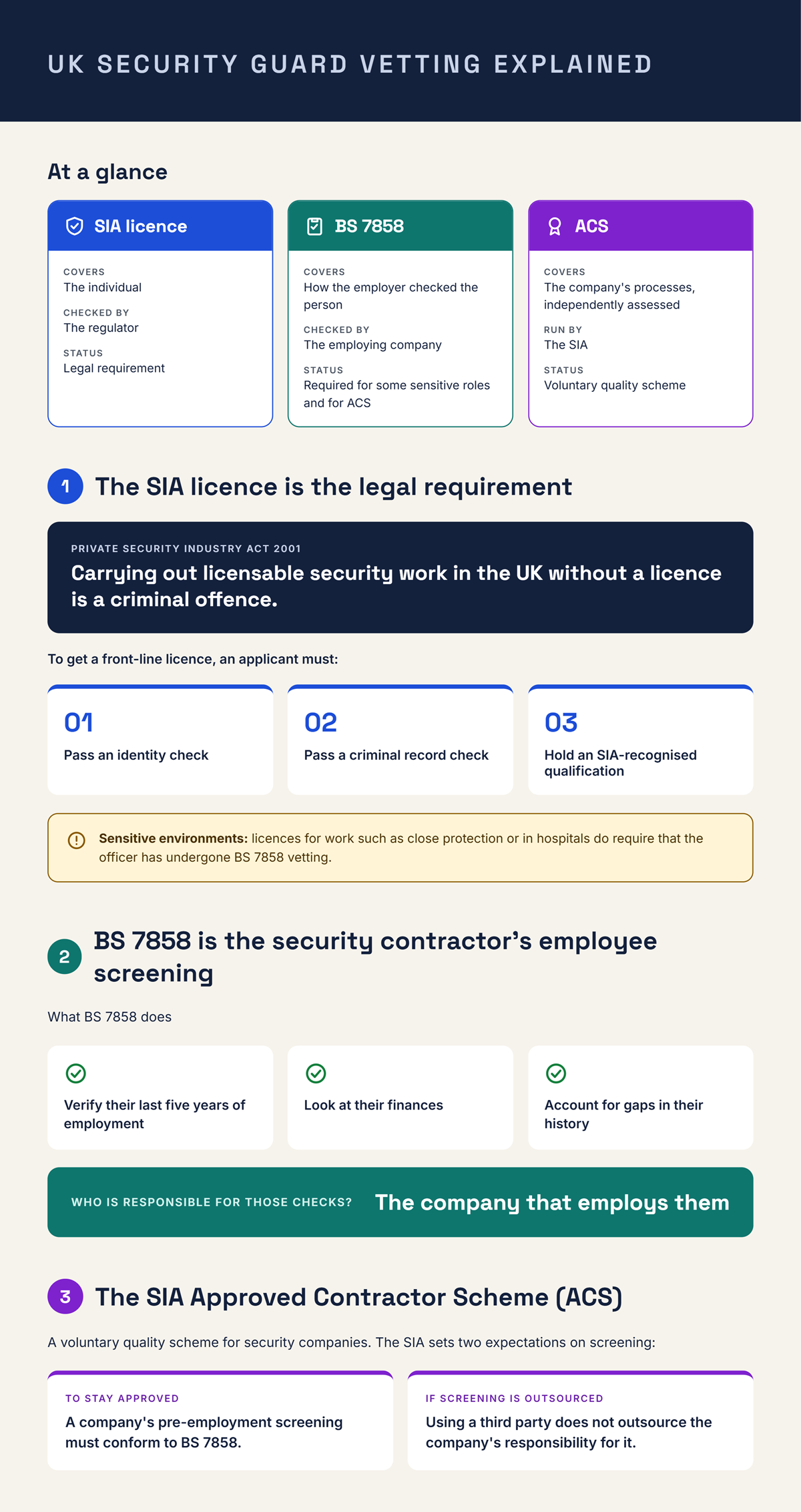
The SIA licence is the UK legal requirement. Under the Private Security Industry Act 2001, it is a criminal offence to carry out licensable security work in the UK without one. To get a front-line licence, an applicant has to pass an identity check and a criminal record check and hold an SIA-recognised qualification. For security work in certain sensitive environments, like close protection or hospitals, the SIA also requires officers to have undergone BS 7858 vetting.
BS 7858 is the contractor’s security guard vetting process. The SIA licence tells you the person passed the regulator’s checks. It doesn’t verify their last five years of employment, look at their finances or account for gaps in their history. The responsibility for carrying out those checks sits with the company that employs them.
The SIA Approved Contractor Scheme (ACS) is a voluntary quality scheme for security companies. The SIA says that to remain an approved contractor, a company’s pre-employment screening must conform to BS 7858, and that outsourcing screening to a third party doesn’t outsource the company’s responsibility for it.
In short, the SIA licence covers the individual, BS 7858 covers how the employer checked them, and the ACS shows that an independent body has assessed a company’s processes.
Vetting outside the UK in the EU
BS 7858 is a British Standard that follows UK standards and procedures. No single equivalent applies across the European Union. Each country regulates private security separately, and vetting usually relies on national licensing and police certificates of conduct. Examples include Germany’s Führungszeugnis (certificate of good conduct) or the Dutch equivalent Verklaring Omtrent het Gedrag (VOG).
What an employer can check also varies. EU data protection law places strict controls on processing criminal record data, and national rules on financial and background checks differ. The depth of screening possible in one country may not be possible in the next.
Businesses throughout the EU recognise the UK BS 7858 standard. It can still help you establish whether a UK contractor has thoroughly vetted the staff it provides for an assignment in Europe. For multinational businesses, that is a real consideration. You want one point of accountability who knows the licensing rules in each country and holds every officer to the same selection standards. The alternative is leaving it to whoever happens to supply staff locally.
How Titan selects partners, subcontractors and security officers
Titan Security began in the 1990s as a direct security provider, and for more than two decades we recruited, vetted, trained and deployed our own officers. That is where our management team learned what good screening looks like, where the shortcuts get taken, and which warning signs to look out for.
Today, like many other large international security operations, we operate mainly as a security procurement provider. We deliver most contracts through a network of carefully chosen local security partners, subcontractors and associates. Titan takes main contractor responsibility, manages the contract and answers to you for the result.
Because we spent so long doing the job ourselves, we know what to ask of the subcontracted companies we partner with, and we can quickly tell the difference between a partner that vets properly and one that only says it does.
It’s a model that only works with strict checks at three levels:
- our procurement processes
- the diligence of the security partners we work with
- the quality of the individual officers assigned to your project.
Vetting our partners and associates
Vetting our partners. Before a security company, subcontractor or associate supplies officers on a Titan contract, it goes through our own vetting procedures. We need to confirm that it holds the right licences where it operates and that its recruitment and screening meet the standard we hold ourselves to.
BS 7858 for complex and sensitive assignments. Where an assignment is complex or sensitive (for example, close protection), we make sure the partner has screened the officers it deploys to BS 7858. That means it has actually carried out the verified five-year history, criminal record, financial and sanctions checks described above, rather than simply assuming them.
Checks on every officer
Across all our contracts, the security guards supplied through Titan pass background checks that cover:
- criminal record checks and offender registers
- employment history and references
- verification of qualifications and certification
- any substantial gaps in employment
Structured interviewing, shaped by our years as a direct provider learning what makes a first-class security officer, and discretionary drug and alcohol screening supplement normal vetting procedures.
Licensing, supervision and specialist roles
Officers working on our UK contracts hold an SIA licence, and officers elsewhere hold licences that meet local requirements. Where it helps, we bring in experienced professionals from across our organisation, and we train and fully supervise all personnel.
For specialist roles, selection often goes further. We choose officers for close protection or concierge security for the personal qualities those roles need, and they receive additional specialist training.
The result for you is dealing with a main contractor who has already done the checking on the companies and the people, whether the contract covers corporate offices, retail stores, warehouses or keyholding and alarm response. You can see how some of that works by reading some of our case studies.
Titan Security Europe is a member of the international Risk Global Management security group. You can find out more about our procurement processes on the Risk Global Management corporate website.
Questions to ask any security provider
Whoever you choose, the answers to these questions will tell you a lot about how seriously a company takes vetting:
- Do you screen to BS 7858:2019, and are you SIA ACS approved? If not, ask what checks they make instead, and how far back they go.
- Is anyone proposed for my site still in the BS 7858 conditional employment stage? If so, when will they complete the checks?
- Who signs off when a check raises a concern? Under BS 7858, accepting that kind of risk needs sign-off from senior management or someone they have formally authorised.
- How do you vet officers outside the UK? Look for a clear answer on local licensing and on how they keep selection standards consistent between countries.
- Do you subcontract, and if so, how do you vet your subcontractors? Partner companies deliver many security contracts partly or wholly. That is fine, provided the main contractor checks those partners and takes main contractor responsibility.
- What happens if an officer isn’t right for my site? You want to know how quickly the provider can replace them, and who supervises them day-to-day.
A contractor who answers these clearly and in writing will be fully aware of the status of the personnel they place on your contract.
Frequently asked questions on Security Guard Vetting
Is BS 7858 vetting a legal requirement?
No. BS 7858 is a code of practice, not a law. The legal requirement in the UK is the SIA licence for anyone doing licensable security work. However, companies in the SIA’s Approved Contractor Scheme must screen their staff to BS 7858 to keep their approval. That is why it has become the benchmark standard for the industry.
How long does BS 7858 screening take?
It depends mainly on how quickly past employers and other sources confirm the applicant’s history. The standard sets an upper limit rather than a typical timescale. The provider must complete full screening within 12 weeks of an officer starting conditional employment, or 16 weeks where the role requires a ten-year history.
Does an SIA licence mean an officer has been BS 7858 vetted?
No. The SIA licence confirms that the individual has passed the regulator’s identity and criminal record checks and holds a recognised qualification. BS 7858 adds the employer’s own checks, including a verified five-year history, financial checks and sanctions screening. A well-vetted officer will have both.
Can I see the vetting file for officers working on my site?
These files contain confidential information, so a provider is unlikely to share them in full. What you can reasonably ask for is confirmation that screening is complete for each officer and the date it finished. You can also ask for each officer’s SIA licence number so you can check it on the public register yourself.
Does BS 7858 apply to security staff working in Europe?
BS 7858 is a British Standard built around UK records and right-to-work rules, so it doesn’t apply directly in other countries. Each European country licenses security work nationally, and employers have to follow each country’s rules on what they can check. If you need security across several countries, ask your provider how they meet local licensing requirements and keep selection standards consistent everywhere.
